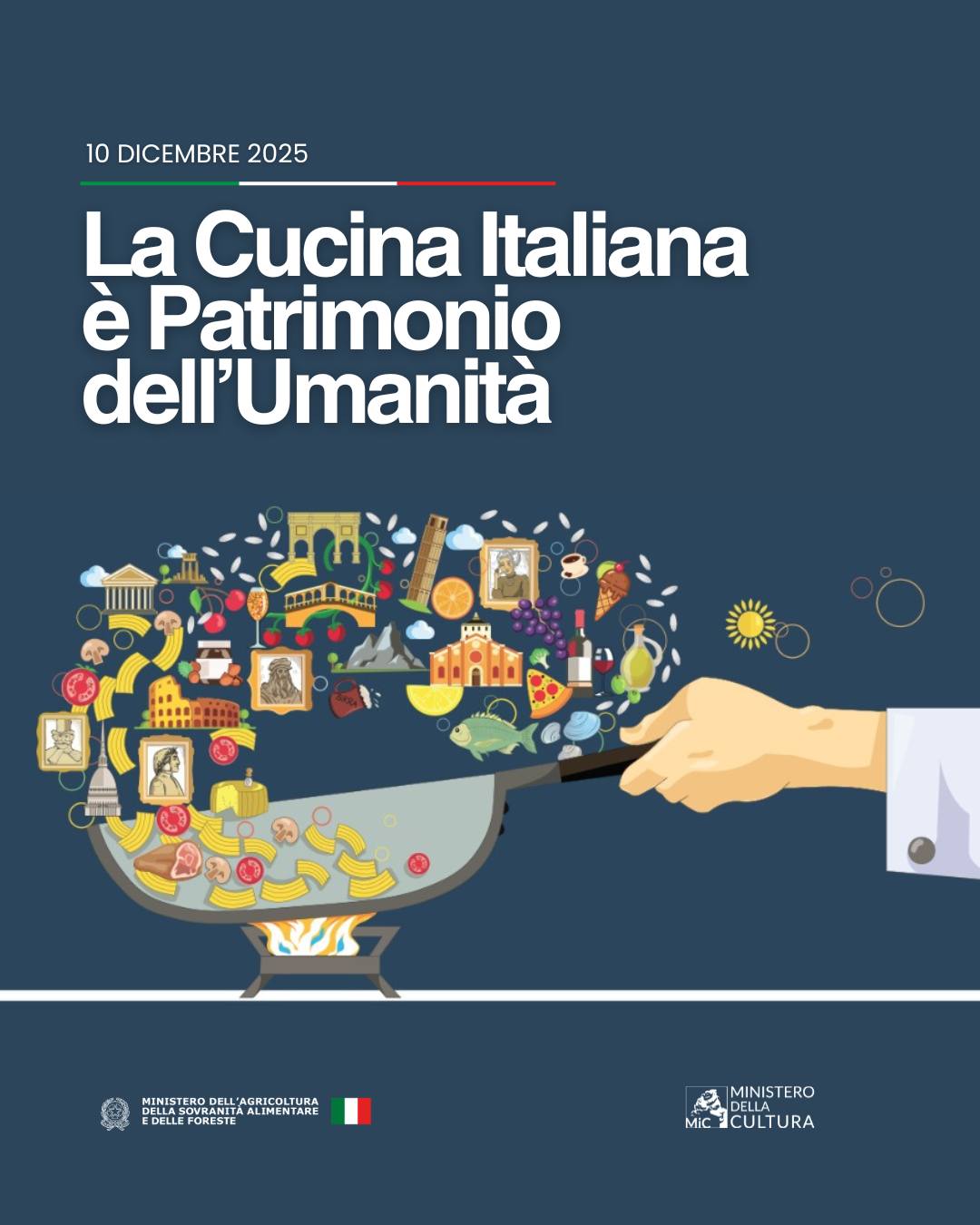
On 10 December 2025, at 10.44 Italian time, in New Delhi, UNESCO's Intergovernmental Committee voted unanimously.
Italian cuisine entered the Representative List of the Intangible Cultural Heritage of Humanity under the title "Italian cooking, between sustainability and biocultural diversity". Sixty dossiers submitted by fifty-six countries. One recognised as the first national cuisine inscribed in its entirety.
No other country had done it before.
That evening the Colosseum was lit up. President Mattarella called the Minister of Agriculture. News agencies ran the story; social media did the rest. Then, as tends to happen, everything returned to its place. Restaurants reopened the next day. The pasta stayed the same.
What UNESCO recognised, precisely
Not the dishes. Not the recipes. Not pizza, not ragù, not risotto. UNESCO recognised a set of practices: shopping at the market, choosing seasonal ingredients, domestic preparation passed down through generations, Sunday lunch as a collective rite. The gesture before the dish. The transmission before the result.
The dossier submitted by the Ministry of Culture — curated by Pier Luigi Petrillo, director of the UNESCO Chair at Unitelma Sapienza University in Rome — did not describe a culinary tradition as an archive of recipes. It described it as a «daily practice»: knowledge, rituals, gestures, creative and artisanal use of materials, a shared socio-cultural identity that is at the same time geographically diverse.
A distinction worth holding onto. Because this is where the recognition becomes difficult to use — and equally difficult to misread.
A world first, with a necessary qualification
Italy is no stranger to UNESCO recognition in the food and drink field. The tradition of Neapolitan pizza-making had been on the list since 2017. The Mediterranean diet — shared with Spain, Greece, Morocco, Portugal, Cyprus and Croatia — entered in 2013. Before that: transhumance, the alberello vine cultivation in Pantelleria, truffle hunting, dry-stone walling.
With the 2025 recognition, Italy reaches twenty-one traditions on the intangible heritage list, nine of which are linked to food and agriculture. No other country holds a comparable proportion in this sector.
What sets this recognition apart is scale: not a single rite, not a localised production, but the entire gastronomic tradition of a nation. France obtained recognition in 2010 for «the gastronomic meal of the French», understood as a sequence of four courses. Italy presented something harder to delimit: a way of being in a kitchen and around a table that cannot be reduced to a menu.
Pier Luigi Petrillo, in an interview with ANSA immediately after the announcement: «Italian cuisine over the years has absorbed everything, and then created something original. The dossier was difficult and complex because this is the first time in the world that UNESCO has recognised an entire cuisine as heritage — with its values, with its differences».
The process. Three years of work and two ministries
The candidacy was launched on 23 March 2023, promoted jointly by the Ministry of Agriculture, Food Sovereignty and Forestry and the Ministry of Culture.
In July of the same year, it was officially set in motion aboard the sailing ship Amerigo Vespucci, departing on a world tour that would call at dozens of ports through to 2025. A symbolic gesture with considerable logistics: Italian food as flag, before it was product.
Supporting the dossier: La Cucina Italiana magazine (founded 1929), the Accademia Italiana di Cucina (since 1953), the Fondazione Casa Artusi (since 2007). Not improvised institutions, but organisations that have spent decades safeguarding archives, recipes, regional culinary grammars.
On 10 November 2025, the first positive technical assessment from UNESCO's advisory bodies. One month later, the final decision. Sixty dossiers examined. Sixty countries or groups of countries that had chosen to say: this is worth safeguarding. Italy submitted one that had no precedent in the category.
The economic impact. What we know and what remains uncertain
Minister Lollobrigida cited precise figures in Parliament: Italian cuisine is worth 251 billion euros, growing at 4.5% annually. It accounts for 19% of the global restaurant market. In 2024, gastronomic tourism generated 40.1 billion euros — up 12% on 2023 and 49% on 2016.
Agri-food exports exceeded 69 billion euros in 2024, with a further 6% increase in the first seven months of 2025. The stated target is 100 billion by 2030.
But the concrete question — what actually changes, in practice, with a UNESCO recognition for an intangible asset? — does not yet have a simple answer.
A point of comparison exists. Since the art of Neapolitan pizza-making entered the list in 2017, professional training courses for pizzaioli have grown from 64 to 246 (across Italy and abroad). Accredited schools have multiplied. Measurable demand.
But pizza is a specific tradition, with an identifiable technique, a defined supply chain, a finished product that can be certified. Italian cuisine in its entirety is something else. Harder to commercialise, and harder to protect.
Petrillo had already said: «A UNESCO candidacy is not undertaken for its economic return. It is undeniable that a heritage designation has an economic impact». The distinction between premise and consequence matters.
Italian sounding. The problem the recognition does not solve
According to data from the Federazione Italiana Pubblici Esercizi, there are today around 600,000 restaurants in the world that describe themselves as Italian. Of these, only a small percentage meets minimum criteria for authenticity: Italian chef, Italian ownership or management, documented use of Italian-sourced ingredients.
The rest is Italian sounding. Evocative names, tricolour flags, pseudo-Italian menus, products that do not come from Italy and in some cases bear no real connection to the original recipes.
UNESCO recognition carries no direct legal force over this phenomenon. It is not a certification mark. It confers no exclusive rights. It does not prevent anyone from calling «carbonara» a dish made with cream and smoked bacon, served in Düsseldorf.
What it can do is strengthen the cultural positioning of Italian cuisine as a recognisable and distinct system. It is one more argument for those working to protect Protected Designations of Origin, Geographical Indications, and territorial marks. Federdoc, for instance, emphasised «the contribution of Denomination of Origin wines, an integral and inseparable part of our gastronomic identity».
What is lost in the simplified version
Whenever Italian cuisine is discussed as heritage, one version tends to prevail: the nostalgic one — grandmothers, slow-simmering sauce, hand-rolled pasta, oral transmission of recipes from some indeterminate past.
In its global success, Italian cuisine has not been betrayed — it has been translated. To travel, it had to become recognisable. Some dishes underwent a process of standardisation to function as emblems. Some variants were marginalised. Some ambiguities were removed. Carbonara became a formula; pizza an icon; cucina povera a narrative brand.
Translation is the cost of scalability. But every translation involves compression — a reduction in variety. What gets lost is the urban context that generated many of the recipes now considered «ancestral». As John Dickie wrote in Con gusto. A History of Italians and Their Food, Italian cuisine has urban roots before rural ones. The real peasant kitchen was, for most of Italian history, a kitchen of poverty: not bistecca alla fiorentina, not chicken liver crostini with Marsala — delicacies the rural poor could only dream of — but a diet built on garlic, pulses, and stale bread. The cucina povera found in restaurants today is largely a later reconstruction, a rebranding carried out in the second half of the twentieth century by a country that had finally left hunger behind.
Pellegrino Artusi, who with La Scienza in cucina e l'arte di mangiar bene (1891) built the first attempt at a shared Italian culinary grammar, wrote explicitly for the «well-to-do classes». The urban bourgeoisie, not the peasantry. Emilian tortellini, Milanese risotto, Tuscan soups: products of a negotiation between local pride and national aspiration — not immutable ancestral rites.
What the simplified version also erases is the awareness that the real peasant kitchen was often a kitchen of necessity, not of aestheticised memory. And it erases the conflictual nature of Italian cuisine: the friction between regions, the absorption of foreign influences, the continuous innovation that has redefined over time what we now call tradition.
The simplified version makes Italian cuisine exportable. But it renders invisible the system that makes it possible. UNESCO recognition does not certify the translated image. It certifies the underlying structure: a set of practices, exchanges, adaptations and transmissions that do not coincide with any single recipe and are not exhausted by any menu.
The UNESCO dossier speaks of «biocultural diversity» and «a mosaic of traditions». Italian cuisine has never been a single thing: it has always been an assembly of local kitchens coexisting under shared values without necessarily converging.
Recognising it in its entirety means recognising this complexity too. Not only Sunday lunch as a rite, but the tension between tradition and innovation, between authenticity and adaptation, between the product that holds value and the one that merely sounds Italian.
The responsibility the title carries
Michelin-starred chef Vito Mollica, on the day of the recognition: «The real point will be understanding whether this recognition reaches the minds of travellers, of those who come to Italy. Whether it will guide them towards more conscious choices — towards restaurants that genuinely respect our gastronomic identity».
Niko Romito, three Michelin stars, described it as «an extraordinary result, one that underlines the cultural value of Italian cuisine in the world».
The Fondazione Vincenzo Agnesi: «UNESCO recognition is not an endpoint, but a responsibility. A commitment to safeguarding knowledge, supporting the agri-food supply chain, investing in training, quality, biodiversity, sustainability and food education for future generations».
All of these positions point to the same thing: the title produces nothing on its own. It produces a context in which producing becomes more recognisable, more defensible, more narratable.
The problem is not the recognition. The problem is what happens the day after.
A note on the comparison with France
The French model of 2010 — «the gastronomic meal of the French», with its sequence of four courses, the paired wines, the service, the mise en place — certified a way of eating as a codified, identifiable, defensible heritage.
Italy chose a different path: not the code, but the system. Not the menu, but the manner.
It is a more ambitious choice. It is also a choice that is harder to translate into concrete instruments of protection and promotion.
The strength of Italian cuisine — its radical variety, the fact that every valley, every village, every family holds variants that would be invisible elsewhere — is precisely what makes it difficult to reduce to a label. It is also what makes it resistant to simplification.
And, for those who know how to look, it is the most interesting point in the entire story.
SOURCES
[1] MASAF — Ministry of Agriculture, Food Sovereignty and Forestry. Italian Cuisine UNESCO Heritage — Official candidacy file. masaf.gov.it
[2] Italian National Commission for UNESCO. Italian Cuisine inscribed on the Representative List of the Intangible Cultural Heritage of Humanity, 10 December 2025. unesco.it
[3] ANSA — Terra e Gusto channel. Italian cuisine, humanity's UNESCO heritage, 10 December 2025. ansa.it
[4] Il Post. What happens when an intangible asset becomes UNESCO heritage, 11 December 2025. ilpost.it
[5] Sky TG24. Italian cuisine, intangible cultural heritage of UNESCO, 10 December 2025. tg24.sky.it
[6] Internazionale. Italian cuisine becomes UNESCO intangible cultural heritage, 11 December 2025. internazionale.it
[7] Federdoc. UNESCO: Italian Cuisine is Intangible Cultural Heritage of Humanity, 11 December 2025. federdoc.com
[8] Italia chiama Italia. Italian cuisine in the world: between global success and the risk of counterfeiting, 9 January 2026. italiachiamaitalia.it
[9] La Terra di Puglia. Italian cuisine UNESCO heritage: from Puglia, a model that speaks to the world, 17 December 2025. laterradipuglia.it
[10] Scatti di Gusto. Italian Cuisine is UNESCO Intangible Heritage: what it means, 10 December 2025. scattidigusto.it
Historical and critical references: John Dickie, Con gusto. A History of Italians and Their Food, Laterza 2007; Pellegrino Artusi, La scienza in cucina e l'arte di mangiar bene, 1891.
Curated by Con Gusto
We select, analyze, and translate Italian food culture into practical taste decisions.
Trending Post

Stay up-to-date
Related Post
A denomination recognised as an area of excellence in 1716, described as "arguably the most famous of the Chianti sub-zones" by a Master of Wine in 2018, and almost absent from the international consumer radar. The reason is in the name.
The denomination with the most extraordinary historical record in Italian wine is almost absent from the international radar. That's not an accident, it's the result of seventy years of administrative simplification.
Any system that manages complex value works when it codifies enough to make context legible, and little enough to avoid destroying what makes that context irreplaceable. Barolo has understood this for two hundred years.