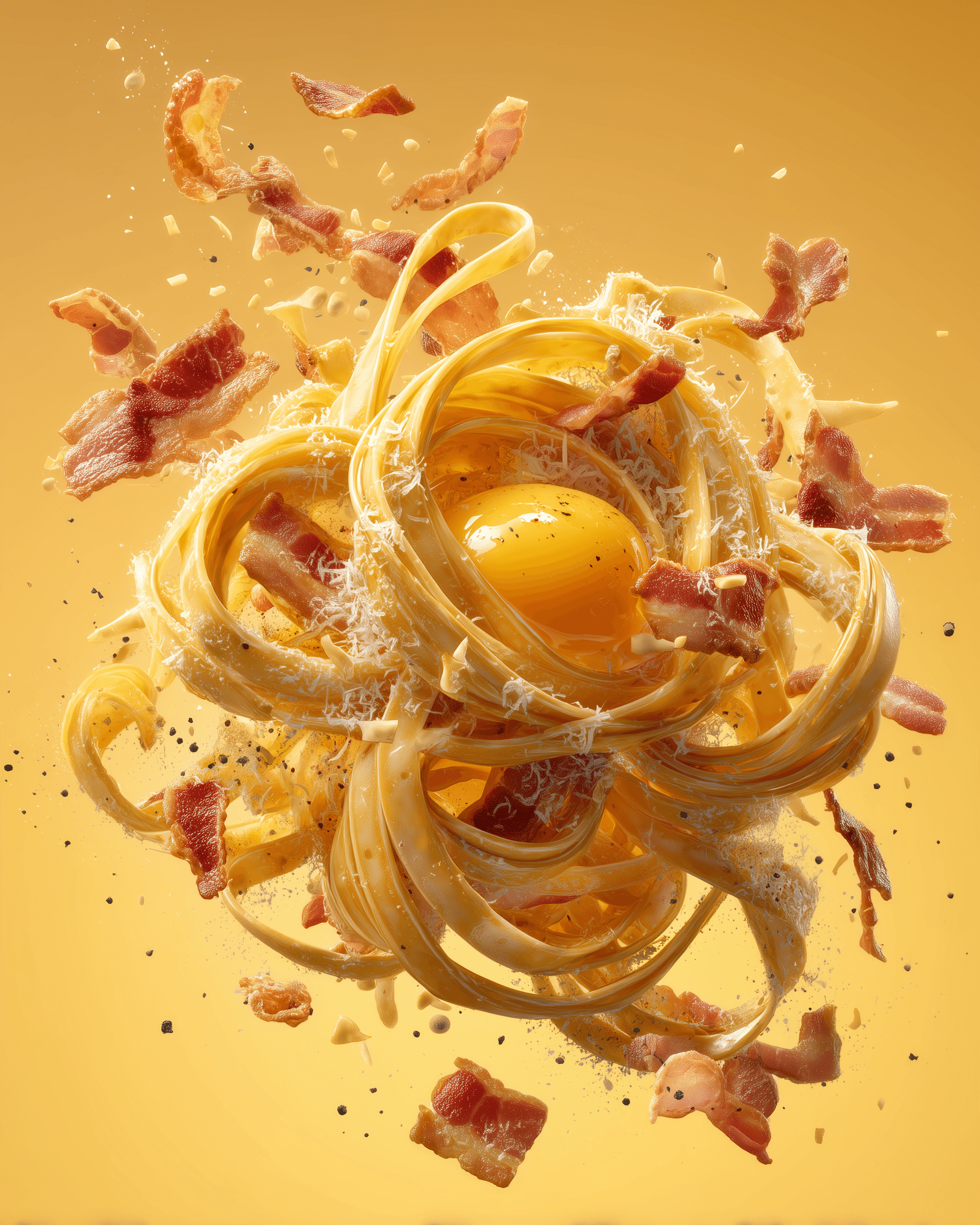
There is a precise point at which carbonara stops being carbonara and becomes scrambled eggs. It has nothing to do with inattention or rushing. It is a matter of temperature. Of proteins. Of molecular networks that close too early, squeezing water out of the structure and turning that fluid, enveloping cream into something opaque, grainy, and unrecoverable.
Carbonara is one of the few Italian dishes where physics condemns you without appeal if you don't know what you're doing. You don't lose it to bad ingredients — you lose it to one degree too many. To ten seconds of distraction. To the assumption that simply "paying attention" would be enough.
What follows draws from the most rigorous analyses available on the subject — scientific writing, food chemistry, technical cooking — to construct a coherent account of what actually happens in that bowl. Not a recipe in the conventional sense. A system.
Four critical nodes
Once the redundancies are stripped out, what remains is a system with four points of failure. Each has a precise chemical logic. Each can be managed — or mismanaged.
Node 1. The guanciale and the Maillard reaction
Guanciale is not fried. It is rendered. Its fat has a melting point between 34 and 44°C — low heat and a cold pan are all that's required. The goal is not immediate crispness but the progressive release of fat, with a concurrent Maillard reaction triggered around 140°C.
The Maillard reaction — the interaction between amino acids and reducing sugars at high temperatures — is responsible for the formation of hundreds of aromatic compounds. It is the same reaction that makes a good bread crust or a properly seared steak irresistible. On guanciale, it produces a sweet, smoky note that has no equivalent in Italian cooking. Guanciale taken beyond 180–200°C forms benzopyrenes: dark, bitter compounds that are chemically distinct from anything being sought.
The rendered fat is not a byproduct. It is an ingredient. It must be separated from the crisp guanciale and used in two distinct moments: a portion in the initial emulsion, a portion added at the end as a final dressing. The sequence changes the structure of the cream.
On substitutions: guanciale cannot be replaced without measurable qualitative loss. The specific ratio of saturated to unsaturated fats, the seasoning with pepper and spices during curing, the aromatic profile developed during rendering — none of it is replicable with pancetta, bacon, or anything else. This is a chemical statement, not a cultural one.
Node 2. The egg and the five-degree window
The egg is the central problem of carbonara. Not for flavour — for physics.
The yolk contains LDL lipoproteins — roughly 85% of its total protein content — which begin to coagulate at 65°C and complete coagulation at 70°C. Five degrees of working range. Below this threshold, the yolk is liquid and aromatic but has no structure. Above it, the proteins expel water from the molecular network: the result is grainy, dry, and unpleasant. A failed omelette, not a cream.
Dario Bressanini, professor of Food Chemistry and Technology at the University of Insubria, was the first to frame this systematically. His observation: the classical approach — pouring hot pasta (100°C) directly into a room-temperature egg cream — works precisely because heat disperses during the mixing. The pasta drops from 100°C to the 65–70°C working range in the time it takes to stir it. Protein coagulation is not instantaneous. Vigorous stirring moves the pasta away from the danger zone before the network closes permanently.
No thermometer is required for the classical approach. What is required is understanding what is happening — so the moment the cream tightens can be recognised, and stirring can stop.
The technical alternative is the savoury zabaglione: whisk the eggs and cheese together in a steel bowl over a bain-marie to 62–63°C, then chill over ice to arrest coagulation, and repeat the cycle three to five times without ever exceeding 63°C. Each cycle progressively denatures the proteins without fully closing the network. The result is a pre-structured cream that handles thermal impact with the pasta more reliably than the raw version.
One rule applies to both methods: once the egg has been added, the pasta does not go back in the pan. Tossing over direct heat after the egg is the most efficient way to destroy the cream.
Node 3. Pasta water as emulsifying agent
Pasta water is not a fallback. It is an emulsifying system.
As pasta cooks, starch migrates into the water. When heated, this starch gelatinises: it increases the viscosity of the liquid and stabilises emulsions. In practical terms, it binds the fat phase (guanciale) to the aqueous phase (egg), producing a stable sauce rather than a broken oil-and-water separation. A study published in Food Hydrocolloids confirmed that starch heated in water increases viscosity and stabilises emulsions in this way — which is why experienced cooks always reserve pasta cooking water before draining.
Starch concentration is inversely proportional to water volume. Cooking pasta in less water produces a denser, more starch-rich liquid that performs better as a binding agent. This is a controllable parameter.
Pasta water is added to the cream progressively, by the spoonful, while stirring. The mechanism is the same as risotto: the pasta absorbs the starchy liquid, releases more starch into the system, and total viscosity increases. The process is gradual and reversible, up to the point where the egg sets.
Node 4. The cheese and the salt balance
Pecorino Romano DOP is not interchangeable. Not on grounds of tradition, but of chemistry. Long ageing — a minimum of eight months for the grating type — develops free fatty acids and aromatic peptides that contribute to flavour complexity in ways a younger or different cheese cannot replicate.
The cheese plays two roles in the cream: aromatic (flavour, complexity) and structural (its proteins contribute to the protein network that holds water). Grating size affects the second function. Coarsely grated cheese does not dissolve completely, creates lumps in the cream, and disrupts the emulsion's structure. A Microplane or equivalent fine grater is not an affectation — it is a technical requirement.
Some preparations use a blend: 20g of Pecorino Romano and 30g of 36-month Parmigiano Reggiano per person. The reasoning is technical as well as gustatory. Parmigiano's different fat profile improves emulsion stability and moderates overall salinity, which with Pecorino alone can tip into aggressiveness.
Salt in the cooking water must be reduced significantly. Guanciale and Pecorino are already salty. Oversalted cooking water creates an imbalance at the end that cannot be corrected.
A carbonara that works
Not a recipe. A protocol built on the four nodes. For four people.
The ingredients
320g pasta — rigatoni or bronze-die-cut spaghetti
160g aged guanciale (40g per person), rind removed
4 egg yolks + 1 whole egg
80g Pecorino Romano DOP aged minimum 8 months, finely grated
40g Parmigiano Reggiano aged 36 months, finely grated (optional but recommended for emulsion stability)
Black pepper, whole, ground at the moment of use — not pre-ground: piperine oxidises rapidly in open air
A note on format: spaghetti becomes increasingly difficult to manage at scale. For more than four people, a short format — rigatoni, mezze maniche — gives better control over the mantecatura. This is not a preference. It is a practical consideration about surface area and heat distribution.
The protocol
The guanciale. Cut into thick strips, roughly 1 cm × 0.5 cm. Start from a cold pan over low heat. Allow the fat to render slowly — the guanciale should sweat, not fry. When the strips are golden and crisp on the outside but still slightly yielding inside, remove them from the pan and set aside. Strain the rendered fat and divide it into two portions. Do not discard it.
The cream. Whisk the yolks and whole egg vigorously in a steel bowl. Mechanical agitation begins denaturing the proteins — this is intentional. Add 80% of the finely grated cheese and continue whisking until fully homogeneous. Add half the freshly ground pepper. Add the first portion of strained guanciale fat. For the zabaglione method: place the bowl over a bain-marie and heat to 62–63°C while whisking, then chill over ice. Repeat three to five cycles, never exceeding 63°C. For the classical method: the cream is ready as is.
The pasta. Cook in lightly salted water — deliberately under-salted. Drain two minutes before the indicated cooking time. Reserve at least 150ml of pasta water before draining.
The mantecatura. Transfer the pasta directly into the bowl with the cream, away from direct heat. Stir immediately and with force. Add pasta water by the spoonful as you work, until the cream is fluid, glossy, and clings to the pasta without breaking. A light bain-marie underneath gives more control. Do not return the pasta to the pan after the egg has been added.
Service. Add the crisp guanciale, the second portion of strained fat, the remaining cheese, and the remaining pepper. Serve immediately. Carbonara waits for no one.
The part science doesn't resolve
There is one thing none of the referenced literature quantifies. It is the only thing that makes a carbonara memorable rather than merely correct.
A carbonara eaten in Rome on a Sunday afternoon, in a place with no pretensions, with half a litre of unlabelled Castelli Romani wine, is worth more than any technically flawless version prepared in the silence of a professional kitchen. Research published in the Journal of Agricultural and Food Chemistry does not say this. But anyone who has eaten carbonara that way at least once already knows it.
Science solves the technical problem. Occasion resolves the rest.
As for the question of origins — did it emerge in 1944 from American K-rations of powdered egg and bacon, or is it an ancient dish of the Roman charcoal workers, or something that crystallised in the years following the Second World War? — the answer is that the complete absence of documented references before 1944 in Italian gastronomical literature is itself data. Neither Corrado (1773), nor Cavalcanti (1837), nor Artusi mentions it. The most Roman dish in Italy may be less than eighty years old.
Irrelevant for the taste. Interesting for everything else.
References
Dario Bressanini, Scienza in Cucina (blog, 2008; reworked in YouTube video, 2020). University of Insubria, Como. Bressanini is the primary source for the protein coagulation analysis throughout this article.
Dissapore, "Ricetta della Carbonara Scientifica" (September 2022). dissapore.com/ricette/carbonara-scientifica/ — source for the savoury zabaglione method and mechanical denaturation technique.
Chimica404, "La Carbonara Scientifica". chimica404.it/la-carbonara-scientifica/ — source for guanciale fat physics and Maillard temperature thresholds.
Scatti di Gusto, "Carbonara, ricetta scientifica in 5 punti" (April 2025). scattidigusto.it/carbonara-ricetta-scientifica-in-5-punti — source for format selection, Pecorino Romano DOP ageing specifications, and pasteurised yolk usage.
Cookist / Virgilio.it, "C'è solo una ricetta per la carbonara perfetta: lo dice la scienza" (April 2025) — source for Food Hydrocolloids (starch emulsification) and Journal of Agricultural and Food Chemistry (Maillard aromatic compounds) study citations.
General reference texts:
- Harold McGee, On Food and Cooking (Scribner, 2004)
- César Vega, Culinary Biophysics (Springer, 2012)
- Dario Bressanini, La Scienza in Cucina (Gribaudo, 2011)
Curated by Con Gusto
We select, analyze, and translate Italian food culture into practical taste decisions.
Trending Post


Stay up-to-date
Related Post

A denomination recognised as an area of excellence in 1716, described as "arguably the most famous of the Chianti sub-zones" by a Master of Wine in 2018, and almost absent from the international consumer radar. The reason is in the name.
The denomination with the most extraordinary historical record in Italian wine is almost absent from the international radar. That's not an accident, it's the result of seventy years of administrative simplification.
Any system that manages complex value works when it codifies enough to make context legible, and little enough to avoid destroying what makes that context irreplaceable. Barolo has understood this for two hundred years.